US Toll Free : +1-800-897-1053 Call or Fax 9.30 to 5.30 pm EST Mon to Fri.
- Language
- Refer $
- Track Order
- Request a Call Back
- %
Finding the right form of contraception is one of the most empowering choices a woman can make in terms of her reproductive health. Choosing the right birth control can make a huge difference in your quality of life, whether you're planning your family, focusing on your career, dealing with hormonal symptoms, or simply trying to space out your pregnancies. This is where the options of choosing among Combination pills and the progestin-only pill come into play. These pills are some of the most popular oral contraceptive pills, which are effective and well-researched methods of reversible contraception in the world. They mainly work by interfering with the normal hormonal cycle that leads to ovulation, preventing pregnancy. If used correctly and consistently in accordance with your doctor's suggestion, they are a very reliable method of family planning, giving a woman direct control over decisions about her reproductive health.
In this blog, we will look at the difference between combination birth control pills and progestin-only birth control pills, how to take birth control medication, who should not take these medications, and what their side effects are.
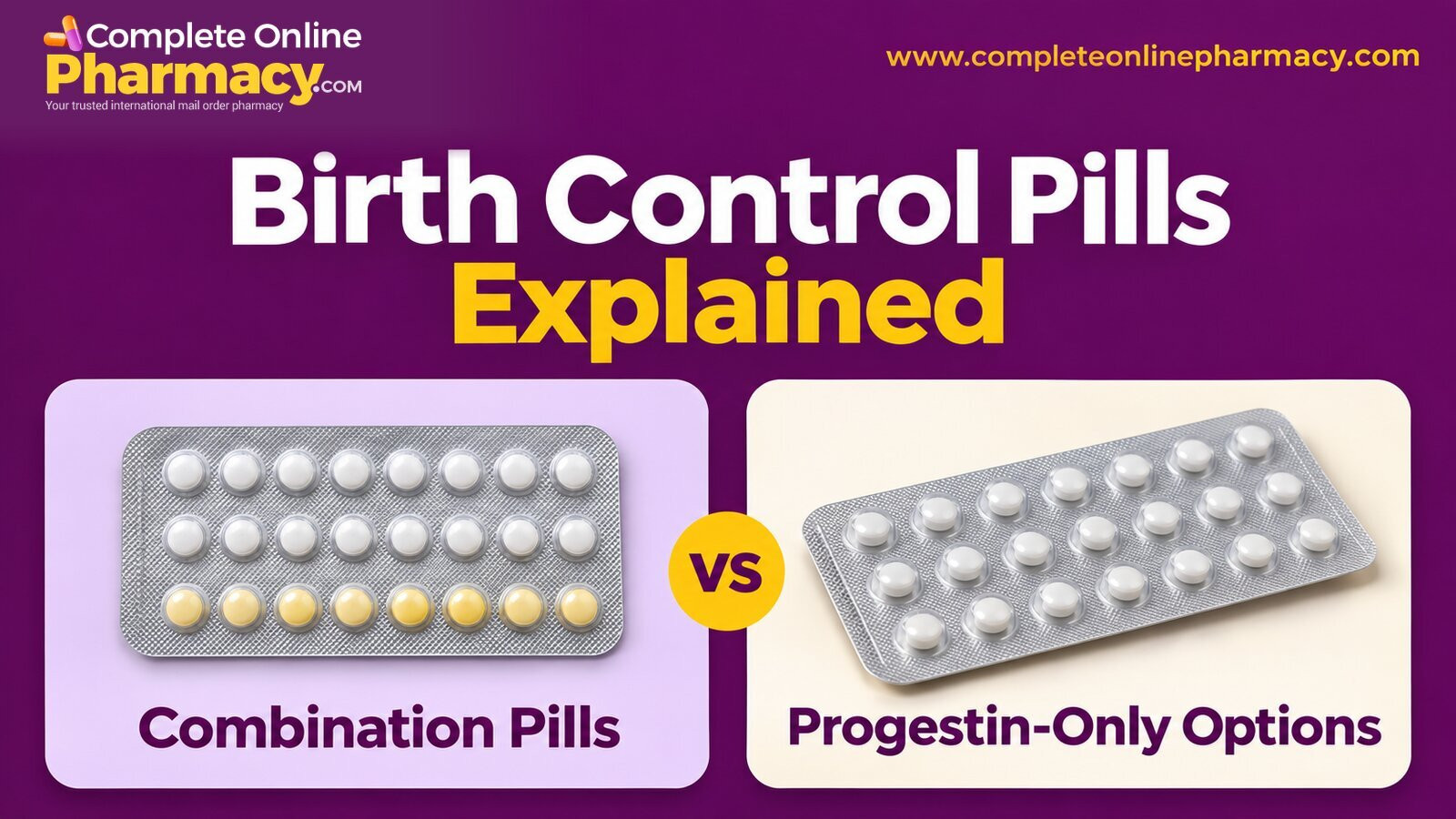
Combination birth control pills consist of both estrogen and progestin, a synthetic progesterone form, a natural hormone in the body. These two hormones can stop pregnancy from happening by altering the ovulation process, thickening the cervical mucus so sperm can not get through, and thinning the lining of the uterus so it is difficult for a fertilized egg to implant. This multi-basis approach is a very effective method of preventing pregnancies.
Combination birth control pills are generally consumed each day for 3 consecutive weeks, accompanied by a week during which placebo pills without hormones are consumed, or no pills are consumed at all. Many women choose to consume placebo pills during the “off” week to maintain the schedule of consuming a pill each day. This reduces the chance of forgetting when it is time to take the actual ones again.
However, some women prefer skipping the placebo week altogether to avoid their period. This should only be done under the supervision of a gynecologist.
The progestin-only birth control pills do not use estrogen. These pills work similarly, but the pregnancy protection they provide is mainly an outcome of the thickening action of the cervical mucus. They also help thicken the uterine lining to stop sperm from reaching the eggs. They are less effective at preventing ovulation.
The progestin-only pill must be taken at the same time each day and does not use a placebo week, which means that women take the hormones consistently. This often results in shorter-duration periods or no periods at all.
There are two types of birth control pills, or oral contraceptive pills: combination pills and progestin-only pills. Combination pills consist of both progestin and estrogen, while progestin-only pills contain only progestin, a synthetic form of progesterone.
Combination pills work in a few ways to prevent pregnancy: firstly, they inhibit ovulation; secondly, they thicken the mucus in the cervix; and lastly, they thin the lining of your uterus. The progestin-only pill, in contrast, works mainly by thickening the mucus in the cervix, making it hard for the sperm to get to the egg. It also thins the uterine lining, making it less receptive to implantation.
The main effect of both pills comes from the progestin. Progestin's main action is thickening the cervical mucus. Another major effect is preventing the hormonal changes responsible for ovulation, which inhibits egg release. Estrogen is thought to contribute to ovulation prevention, but its major role is maintaining a normal cycle.
In short, see the table below:
|
Feature |
Combined Pill |
Progestin Pill |
|
Hormones |
Estrogen+Progestin | Progestin only |
|
Greater Effectiveness |
Over 99% | Over 99% |
|
Typical-use effectiveness |
91% | 91% |
|
Duration |
Once daily; 7-day break or placebo week | Same time daily (traditional: within 3 hours) |
|
Good for |
Many users; also helps with acne, periods |
Breastfeeding, smokers over 35, those who can’t take estrogen |
Combination pills are typically taken orally daily. They are usually taken daily for 21 to 28 days, followed by a break or a week of placebo pills. A combination pill is considered late if it is taken more than 24 hours after the scheduled time. Take the missed dose as soon as possible, even if it means you’re taking two pills in one day. If you’ve missed more than 2 pills in a row, take the most recent pill and use a backup contraceptive method for the next 7 days.
Progestin-only pills require strict adherence and timing. You must take them every day at the same time (within a 3-hour window) to stay effective. A progestin-only pill is considered missed if you take it 3 hours or more outside of the typical timing. If you missed a pill, take it as soon as possible. This may mean you take two pills on the same day. You are also required to use backup contraception, such as a condom.
For most individuals, both types of oral contraceptives are safe. However, both contraceptive medications have contraindications, meaning you should not take them if you have the following conditions.
You shouldn’t take oral contraceptives if you:
Are pregnant
Have undiagnosed vaginal bleeding
Have had or have breast cancer
Progestin-only pills are primarily recommended for certain individuals who may have specific medical conditions or situations that make them unable to take estrogen-containing contraceptives:
Progestin-only pills are recommended if you fall into any of the groups mentioned below:
Are within 6 weeks of delivery
Are 35 years or older and smoke
Have a history of a blood clot
Have uncontrolled high blood pressure or diabetes
Heart disease
Have migraines with aura
Have active liver disease (except severe ones like severe cirrhosis, liver tumors, or acute hepatitis)
You may notice that many of the contraindications link to heart disease and blood clots. This is because estrogen is sometimes linked to an increased risk of heart-related events. If any of the above-mentioned conditions apply to you or your risk is greater than that of a typical individual, your healthcare provider will often recommend that you avoid combination pills.
Both medications have some possible side effects. Although not every patient will experience any or all of these effects, it’s good to know what you may experience while on either medication.
These side effects tend to be worst during the first three months. After this point, symptoms typically resolve considerably or completely. Because of this, it’s often advised that you stick with one contraceptive for 3 months before switching due to side effects, unless they are severe. The most common side effects with contraceptive pills include:
Bloating
Nausea
Spotting
Headaches
Breast tenderness
Irregular periods
Weight gain
Progestin-only contraceptives typically cause more menstruation-related side effects such as irregular periods and spotting; combination pills commonly have a greater variety of effects. In general, combination pills typically cause more serious side effects, but this isn’t true for everyone.
Generic Birth Control Pills are safe and highly effective for most people when taken consistently. Still, the right choice depends on an individual’s overall health, and you can avoid pregnancy as long as you remember to take it every day. There are two types of birth control pills: combination pills and progestin-only pills. The most commonly prescribed option is the combined pill, which can help regulate periods, reduce acne, and offer a bit more flexibility with timing, but do not take this medicine if you are over 35 and smoke. On the contrary, progestin-only pills, which don’t contain any estrogen, may be a better fit for certain groups of people, such as those who have a history of blood clots or heavy periods.
What is clinically appropriate for you depends on a range of factors, including your age, health history, and goals. Both are safe and effective when used as directed, and the right one depends on your needs and preferences. Talk to your doctor about what type of birth control pills are best for you before you start taking them.
There are two types of birth control pills based on ingredients: combination birth control pills and progestin-only pills (minipills).
The hormonal action of combination birth control pills is complex and multi-faceted. A steady, regular dose of progestin and synthetic estrogen in the active pills works to override your body’s natural hormonal fluctuations.
Combination pills have 2 hormones: estrogen and progestin. Taking 1 pill consistently will help you stay protected from pregnancy. On the other hand, progestin-only pills have 1 kind of hormone, i.e., progestin; these pills don’t have any estrogen. You must take a progestin-only pill within the usual 3-hour window every day to be protected from pregnancy.
When taken consistently and correctly, combination and progestin-only pills are more than 99% effective at inhibiting pregnancy (fewer than 1 pregnancy per 100 users per year).
Missing a pill can cause your hormone levels to drop, which can lead to breakthrough bleeding (spotting), nausea, mild cramping, and a higher chance of ovulation and unplanned pregnancy.
 10%
Reorder
 We will match

 and Earn



Comments